
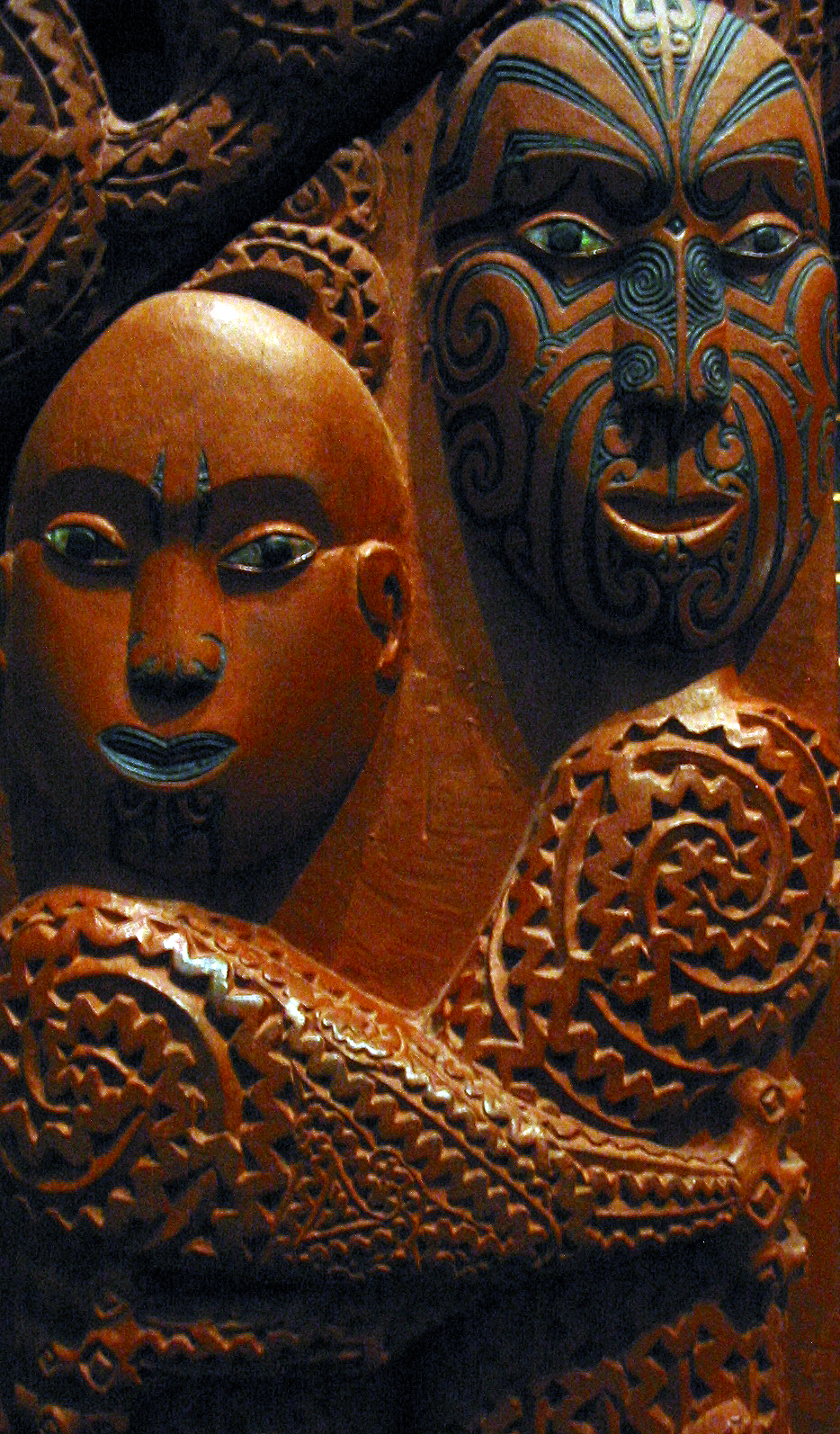
Around 700 years ago, the ancestors of the modern day Māori people first landed on the shores of Aotearoa.
With them, they brought a wealth of knowledge, customs, and traditions.
One such story is about the creation of all things, according to some Māori myths.
This is an embellished story of the separation of Rangi and Papa. For the main points of the myth, please look here or here. Enjoy!

━━━━━━・ ꩜ ‧.°. 𖦹.°.‧ ꩜‧.°.𖦹 .°.‧ ・━━━━━━
In the beginning, there was only Te Kore.
Te Kore was both everything and nothing at once. For aeons, Te Kore existed on its own.
Then, from Te Kore emerged Te Ao and Te Pō. The process of creation had finally begun.
From Te Ao, the light and day, and Te Pō, the darkness and night, emerged Ranginui and Papatūānuku, the primogenitors of all that was yet to come.
Ranginui, the heavenly sky father, and Papatūānuku, the earth mother, were locked eternally in a tight embrace. So deep was their love for each other that they refused to be separated, and not even light nor time could pass between them. Each peak and valley of Papatūānuku‘s warm, life-giving body was matched by the curves and arches of Ranginui’s own. Their union was sweet, with tender words and gentle kisses frequently exchanged between the two lovers, and begot numerous children.
Unfortunately, these children were born into a claustrophobic world of darkness.
Although Rangi and Papa loved each other dearly, it resulted in a cramped life of torment and discomfort for their children. The anguish of their children landed on deaf ears and closed hearts, as nothing mattered more to the lovers than each other.
As long as Ranginui had Papatūānuku, nothing else mattered. As long as Papatūānuku had Ranginui, nothing else mattered. Not even the children that had been born out of their perpetual love.
One day, their child Tāne gathered his siblings and vocalised his frustrations.
”I can’t bear to live like this anymore!” he cried, crawling around on all fours as his siblings surrounded him in the same position.
Ever since they had been born, none of them had been able to stand tall; Ranginui’s unyielding body rendered it impossible. They were all resigned to crawling on their mother if they wished to move anywhere, and even then it was no easy feat.
”I agree,” concurred Tāne‘s brother Tangaroa. “Even death would be better than the world we live in now.”
”Don’t say such things,” chided Rongo, another brother. “Surely there must be another way for us to free ourselves from our parents.”
”Why don’t we just kill them?” suggested yet another brother named Tū. His siblings cast him wary glances – although they knew Tū meant well, sometimes his ideas were a bit extreme.
”How could you be so cruel?!” snapped Tāwhirimātea, another brother. “How about I kill you first!”
”Let’s not do that,” hurriedly interjected another brother, Haumia. “They are our parents, after all. And we’re all brothers here. Let’s not shed blood unnecessarily.”
”But if we kill them, then they can’t hold onto each other anymore!” argued Tū, urging his brothers to see his reasoning. “Once they let go of each other, we can finally be free!”
”Separating them would be the harshest thing we could possibly do!” shot back Tāwhirimātea, who was against the idea of separating their parents. “I won’t forgive any of you if you try to do anything!”
”You won’t need my forgiveness if you’re dead!”
An argument broke out between the brothers, as some agreed with Tū‘s dramatic idea, while others were staunchly against it. During the bickering, Tāne mulled over his brother’s logic. Tāwhirimātea eventually crawled away angrily from his brothers to go and clear his head. He couldn’t believe that they would be willing to separate their parents, who loved each other so dearly.
Then, Tāne had an idea.
”I’ve got it!” Tāne announced loudly. He hushed his squabbling siblings, and proposed his solution.
”Well, spit it out, then,” huffed Tū, looking away in disdain. Beside him, Rongo placed a comforting hand on his shoulder, only for it to be smacked away.
”You had a point with the separation idea,” stated Tāne, giving his brother credit for trying. “But we needn’t kill them to do that. All we have to do is separate them!”
”And how do you propose we do that?”
”Well…” Tāne hesitantly got onto his feet, only able to squat. Placing his palms flat against his father’s rigid body, he attempted to straighten himself up and push his father away. Alas, Ranginui didn’t even budge.
”Let me try,” insisted Tangaroa, shuffling next to Tāne. Getting in the same position, he tried and failed to make any progress. One by one, the brothers all took turns individually, and then together, but to no avail. Ranginui remained unmoved.
For what seemed to be an eternity, the brothers all took turns trying to push their father off of their mother.
”I can’t do this anymore,” groaned Tāne, laying on his back and staring up at his father’s dark torso. He could hear Tū and Tangaroa heaving futilely, and swung his legs up so that his feet were pressed against his father’s skin.
He was struck with another idea; but this time, he didn’t announce it.
Instead, Tāne slowly pushed his shoulders against his mother, and slowly began to stretch his legs.
Inch by inch, he could feel his knees shaking – but he knew that meant it was working.
One, two, three, four, five – after what felt like eternity, Tāne heaved and fully extended his legs.
Light flooded in.
There were gasps around him as his siblings realised what had happened, and Tāne, still laying with his legs outstretched, looked just as surprised.
”Ow!” cried one of his brothers, covering his eyes at the sudden explosion of light. “What happened?”
One by one, Tāne‘s brothers slowly rose to their feet. For the first time since their births, they were finally able to stand tall – and also see each other’s faces properly.
”Is this real life?” asked Tangaroa incredulously, looking around into the bright void. Behind him, their other siblings jumped in excitement and wept in joy.
”You’re all uglier than I thought,” snorted Tū, earning a smack on the head from both Haumia and Rongo.
Tāne, seeing his parents bare, immediately clothed each of them. For Ranginui, he placed the sun, moon, and stars to adorn his exposed body, and for Papatūānuku, he created the trees, grass, and other aspects of nature to clothe her.
However, their celebration of freedom didn’t last long. From a distance, they could see their final brother sprinting towards them in unbridled rage.
”HOW DARE YOU!” screamed Tāwhirimātea, turbulent and tempestuous in his approach. “I’LL KILL YOU ALL FOR WHAT YOU’VE DONE!”
The celebrating brothers took one look at each other, before they each fled to what would become their new, respective domains.
”Ha! It’s one of you against all of-“ Tū stopped mid-sentence as he looked around, seeing that his brothers had all vanished. “You cowards!”
Seething, Tāwhirimātea raged against Tū, summoning great winds and rains against him. Tū, who was never one to back down from a fight, stood his ground and persevered against his blustering brother.
Meanwhile, those who had escaped had now become rulers of their own dominions.
Tāne had fled into a forest, and become the lord of nature and its birds.
Tangaroa had dove deep into a river, and become the lord of the sea, rivers, and all of their creatures.
Haumia and Rongo, who had been the slowest to depart, had been sheltered by Papatūānuku and buried deep within her bosom – thus making them the gods of wild produce and agriculture, respectively.
Out of the fighting gods, Tāwhirimātea had become the lord of the skies and weather, commanding the fierce winds and rains.
Tū, steadfast and strong, had become the god of war and humanity.
However, Tū could not withstand Tāwhirimātea for long. He withdrew in the end, cursing as he fled Tāwhirimātea‘s wrath.
Tāwhirimātea, who was also exhausted from his stand off with Tū, promised to wage war on his brothers for as long as he could. He then flew into the sky to live with his father, Ranginui.
Tū, who was still angry at his brothers for abandoning him, decided to chase them down and get revenge.
He went deep into the forests, setting up traps to capture the birds, who were the children of Tāne, and then ate them. He then cut down the trees, and used them to make boats.
Using these boats, he sailed into the sea and used nets to capture the children of Tangaroa and then ate them as well.
Finally, Tū created tools and used them to plow the earth. With them, he dug up the children of Rongo and Haumia, and ate them.
Because of this, humanity also gained knowledge on how to capture birds, use trees for their wood, how to fish and catch sea creatures, and how to plow the earth for its vegetables.
However, because Tū could not defeat Tāwhirimātea in battle, humans also cannot conquer bad weather and strong winds, and must seek refuge during these times.

 Tales of Oceania
Leave a comment